

Designing Engagement Photos With a More Timeless Look
Key Takeaways
- Engagement photos can include movement, camera-aware portraits, and candid-looking moments; the best mix depends on the couple and intended style.
- Choose clothing that feels like you, works with the location, and supports the visual style you want rather than following one required color palette.
- Select locations for personal meaning, visual fit, access, and comfort rather than assuming natural settings are automatically more timeless.
- Natural light, artificial light, mixed light, and different editing approaches can all work when they fit the photographer’s style and the couple’s preferences.
- A varied gallery can include direct portraits, movement, quiet expressions, and interaction without promising how the images will feel years later.
Engagement photos can remain meaningful for years, but there is no single formula that makes an image timeless. Trends, personal taste, editing, clothing, locations, and even what feels nostalgic can all change over time.
At Kelly Tareski Photography, we approach timelessness as a matter of intentional choices rather than a guarantee. This guide explains how posing, clothing, location, lighting, and editing can be planned to create engagement photographs that feel coherent and personal.
What Can Make Engagement Photos Feel Timeless
Choose the Mix of Movement and Structured Posing
Engagement sessions can include movement and interaction, camera-aware portraits, or a mix. One approach is not inherently more timeless than another. The useful goal is to choose direction and posing that fit the couple, location, clothing, and intended mood without forcing uncomfortable positions.
Older engagement portraits often reflect the posing conventions of their era, while current work may lean more toward movement or documentary influence. Neither approach is inherently more meaningful; the important question is whether the pose and expression fit the couple and the photographer’s style.
Clothing and Color Choices That Endure
Clothing and color affect the visual feel of an engagement session, but no palette is automatically timeless. Neutrals, strong colors, patterns, texture, formal clothing, and casual clothing can all work when they fit the couple, setting, and intended use.
Wardrobe can be flowing, structured, tailored, casual, monochrome, layered, patterned, or minimalist. Choose the number of outfits around the session length and how much variety you want, without assigning clothing formulas by gender or treating one color combination as universally better.
Emotion Over Performance
Expression and interaction can make engagement photographs feel personal, but camera-aware portraits can be just as meaningful as candid-looking moments. Instead of treating one type of emotion as universally superior, aim for a gallery that reflects the way the couple actually wants to be represented.
Communicate with your photographer before the session about your comfort level with physical affection. If you’re reserved with PDA, your photographer can guide you toward poses that feel natural while still capturing connection-like walking hand-in-hand, looking at each other mid-conversation, or sitting close without excessive touching. The best photographers create space for these moments to emerge rather than demand them.
Building Comfort During Your Session
Some couples settle in immediately while others need more time. There is no required 15-minute warm-up. The photographer can begin with simpler direction, movement, conversation, or camera-aware portraits and adjust the pace as the session develops.
Photographer direction can range from detailed posing to lighter prompts depending on the couple and the desired gallery. Collaboration is useful because it lets you adjust the amount of direction, interaction, and camera awareness rather than assuming candid-looking photographs are always the most authentic choice.
Location and Setting Strategies for Longevity
How Natural Landscapes Affect the Look
Location affects the visual context of engagement photographs, but natural scenery is not automatically more timeless than architecture, neighborhoods, studios, or places with personal meaning. Choose a setting because it supports the couple’s story and the intended look, not because one category is assumed to age better than another.
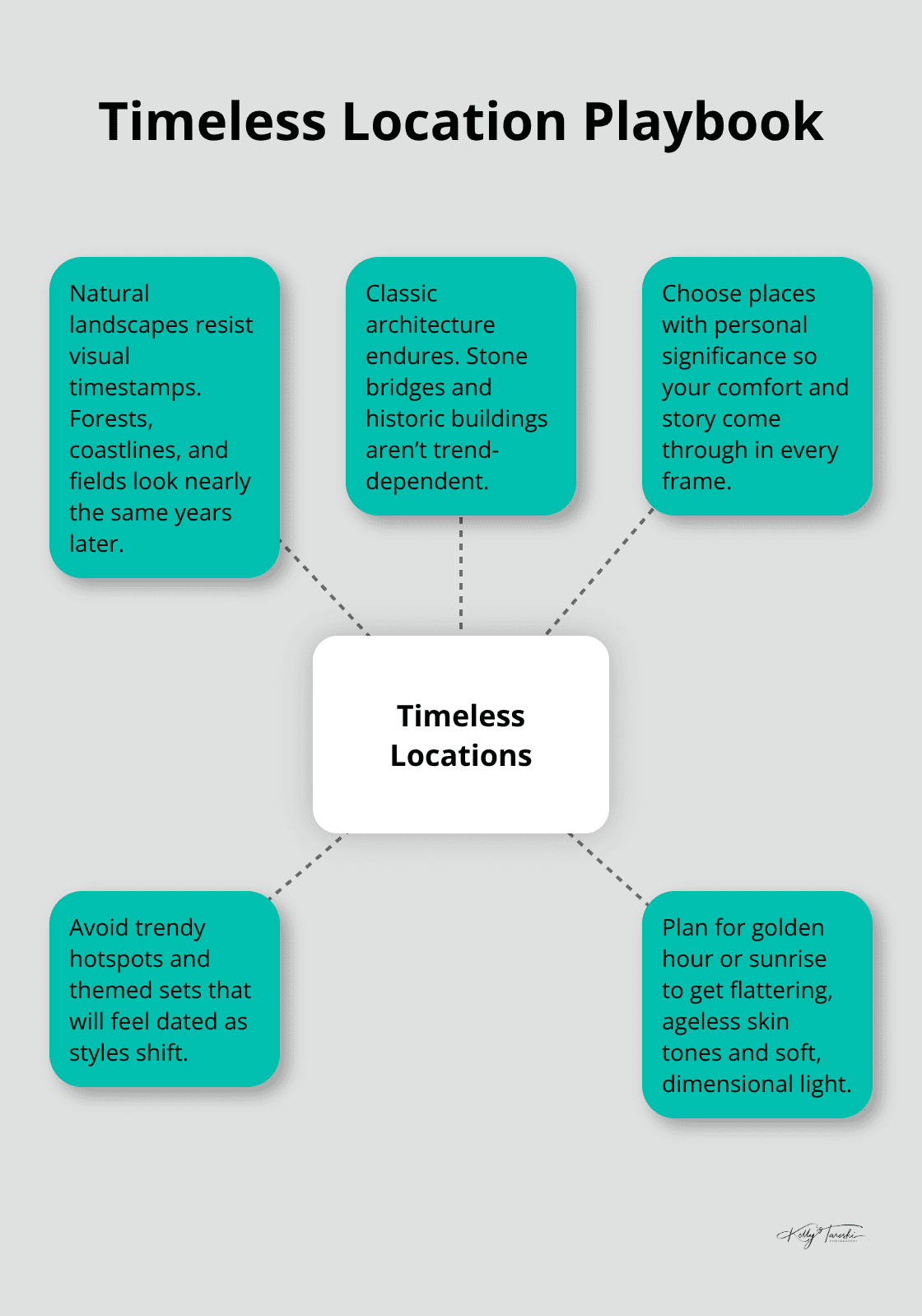
Locations tied to the relationship can add personal context, while visually strong locations with no prior connection can also work well. Personal meaning is one consideration among access, light, privacy, weather, travel, and the overall visual plan.
How Era-Specific Venues Affect the Look
Popular venues, themed spaces, seasonal settings, gardens, rooftops, and historic locations can all work. A setting that clearly reflects a particular era is not automatically a problem; sometimes that context is part of what makes the photograph meaningful later. Choose the place for the look and story you want rather than trying to eliminate every sign of the present.
How Lighting Choices Affect the Look
Lighting changes contrast, color, texture, and mood. Lower-angle evening light can create a warm look, but open shade, overcast conditions, direct sun used intentionally, flash, indoor light, and studio light can also work well. Location and lighting should support the desired style rather than follow a universal golden-hour rule.
Morning, evening, overcast, midday, indoor, and mixed-light sessions can all work with the right approach. The useful time depends on season, weather, access, comfort, and the desired look rather than a fixed number of minutes around sunrise or a rule that midday must be avoided.
Editing Choices That Stand the Test of Time
Artificial light, natural light, mixed light, and more stylized editing can all be legitimate creative choices. What matters is whether the technique fits the couple and the photographer’s intended style. Avoid treating natural light or minimal editing as the only path to a lasting result.
Technical Approaches to Creating Lasting Images
Composition Principles That Transcend Time
Composition choices such as centered framing, the rule of thirds, leading lines, symmetry, negative space, and environmental context can all work. Use the approach that supports the subject and location rather than treating one composition as naturally timeless or another as dated.
Diagonal, horizontal, vertical, centered, and asymmetrical compositions each create different visual energy. Their usefulness depends on the scene and the intended result rather than a fixed rule about how viewers’ brains will respond.
Editing for Elegance, Not Trends
Editing style can be restrained, stylized, warm, cool, high-contrast, muted, or more natural. Trends change, but that does not make one editing approach inherently wrong. Choose a photographer whose current work already matches the look you want.
Some photographers keep a gallery highly consistent, while others intentionally vary color and treatment between scenes. Ask to see complete galleries so you understand how the photographer handles consistency and variation across a full session.
Variety Within Your Session
A mix of close-ups, environmental portraits, camera-aware images, and movement can provide useful variety when the session allows. Plan that variety around how you expect to use the images rather than assuming one set of compositions will serve every purpose for decades.
Final Thoughts
Engagement photos can become meaningful records of a specific stage in a relationship, but no photograph can guarantee how someone will feel about it years later. Their value may come from the people, place, clothing, expressions, and memories connected to the session.
Planning helps when it clarifies what you want from the session. Choose a photographer whose work, direction, communication, and editing fit your preferences, then discuss the level of posing, interaction, location context, and styling you want in the final gallery.
Before your session, communicate clearly about expectations, locations, wardrobe, and your comfort with different kinds of posing or physical affection. Engagement photography can be natural-light or studio-lit, candid-looking or posed, classic or more stylized; the best fit is the one that reflects how you want to remember this stage.
Education Most Searched Articles
- Kelly Tareski Photography Homepage
- How to Choose Background Colors to Complement Skin Tones
- Choosing the Best Lens for Stunning Senior Portraits
- 5 Tips Using the Nikon Z7ii Camera for Portrait Photography
- Exploring Spokane Through a Lens: Must-Visit Photo Locations
- How to Choose the Best Lenses for Senior Portraits
- When to Use a Neutral Background in Photography
- Top Posing Ideas for Solo Portraits: Looking Confident and Natural
- The Economy and Photography
- How the Economy Impacts Photography
- How to Weather Economic Slumps as a Photographer
- Finding Creative Ways to Promote Your Photography on a Budget
- Free and Low-Cost Resources for Photographers