
Arranging Family Photos: Shelves, Tables, and Small Displays
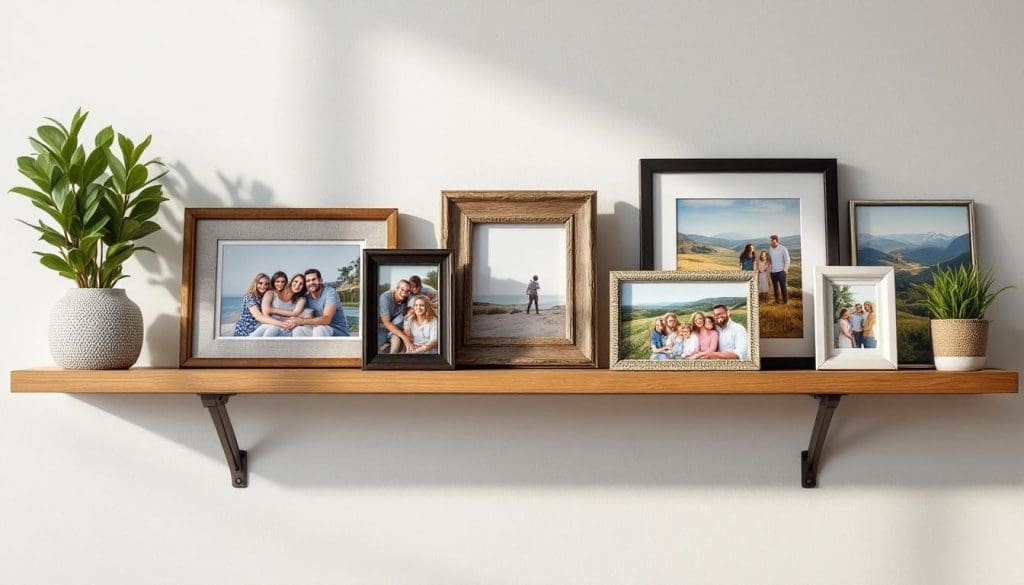
To arrange family photos for a small display, choose one main image, add a few supporting photographs, and leave enough space for each face to be seen. Repeat a frame finish, mat color, or visual theme to connect the collection. A shelf or tabletop can tell a family story without becoming a crowded miniature gallery wall.
I am Kelly Tareski, a family portrait photographer in Nine Mile Falls near Spokane. When thinking about finished artwork, I suggest beginning with where you will actually enjoy it. A bedside table, a living-room shelf, and a hallway wall call for different arrangements. This guide focuses on shelves, tables, and smaller displays; the family photo wall-display guide covers larger wall planning.
Which family photographs belong together?
Start with a connection, not a required number of frames. Your display might bring together a full-family portrait and two smaller relationship photographs, show one child at different ages, or pair a recent portrait with an older family image. Choose photographs you want to look at often.
A mix of posed and candid images can work, but there is no ideal percentage. A quiet portrait may deserve to stand alone. Several animated moments may feel better in an album than in a compact display. For a larger collection, explore how to select images for a family album.
How do you arrange family photos on a shelf?
Empty the area before starting. Place the image you want noticed first, then add supporting frames one at a time. Varying frame height can create a relaxed arrangement, while similar frame sizes can give a more orderly look. Neither approach is inherently better.
- Choose a main photograph that reads clearly from across the room.
- Add smaller images that contribute a different person, relationship, or moment.
- Keep faces and important details visible when frames overlap.
- Step back to check the arrangement from the usual viewing position.
- Remove anything that makes the collection feel crowded.
Use stable frames and suitable mounting or support for the surface. Avoid precarious stacks, overloaded shelves, or heavy objects placed where they can be pulled down. Follow the frame and shelf manufacturer’s instructions rather than relying on appearance alone.
What works on a table, desk, or bedside surface?
Choose a smaller collection that leaves the surface usable. One portrait and a modest supporting frame may be enough. On a desk, check whether the photograph remains visible when the workspace is in use. On a bedside table, allow room for the items that need to live there.
Look at the photograph from the angle where you normally sit or stand. Reflections, frame depth, and the size of the faces can affect whether the image is easy to enjoy. A full extended-family portrait may need more display space than a close portrait of two people.
Do the frames and photographs need to match?
No. Repeating one element is often enough. You might combine different frame shapes with the same finish, use a consistent mat color, or group photographs that share a quiet palette. A vintage photograph can sit beside a contemporary portrait without disguising their differences.
Keep the people more important than the design rule. Do not convert an irreplaceable original to black and white or crop away meaningful details just to make it match. Work from a copy when exploring an alternate presentation.
How can you rotate photographs without losing the family story?
Keep one familiar portrait in place and change the supporting images for a new family chapter, celebration, or season. Store the other photographs together with identifying information so that rotation does not become a pile of anonymous prints.
For handling and storage, follow the Library of Congress guidance on caring for photographs. It recommends limiting light exposure, avoiding unstable storage conditions, and handling prints without touching the image area. Display copies of fragile originals where appropriate rather than treating sentimental value as proof of durability.
Questions about arranging family photos
How many photographs should I put on one shelf?
There is no universal number. Start with a small group, leave clear space around it, and add only images that improve the display. The dimensions of the shelf and frames matter more than a fixed formula.
Can I combine old and new family photographs?
Yes. Their connection can be the people or story rather than matching colors. Add names and dates to a separate record so future family members can identify everyone.
What should go in a gallery wall instead?
A larger collection or a portrait that needs greater scale may work better on a wall. Use the family gallery-wall planning guide for that project.
Plan photographs for the places you live
Bring a photograph or measurements of your intended display area when discussing artwork. Explore my Spokane-area family portrait sessions, review current investment information, or contact Kelly Tareski Photography to begin planning.
Education Most Searched Articles
- Kelly Tareski Photography Homepage
- How to Choose Background Colors to Complement Skin Tones
- Choosing the Best Lens for Stunning Senior Portraits
- 5 Tips Using the Nikon Z7ii Camera for Portrait Photography
- Exploring Spokane Through a Lens: Must-Visit Photo Locations
- How to Choose the Best Lenses for Senior Portraits
- When to Use a Neutral Background in Photography
- Top Posing Ideas for Solo Portraits: Looking Confident and Natural
- The Economy and Photography
- How the Economy Impacts Photography
- How to Weather Economic Slumps as a Photographer
- Finding Creative Ways to Promote Your Photography on a Budget
- Free and Low-Cost Resources for Photographers