

Professional Headshots for Profiles, Bios, and Career Materials
Key Takeaways
- A professional headshot can provide a current visual reference on recruiting and professional profiles, but hiring decisions depend on far more than the photograph.
- A professional headshot can provide a current visual reference on a profile, but it does not guarantee views, interviews, recruiter messages, or hiring outcomes.
- A current headshot can provide a consistent visual reference across professional platforms without guaranteeing hiring or recruiting outcomes.
- Using a recognizable current image across important professional platforms can reduce confusion, but there is no universal replacement schedule.
- Professional photography is a reusable communication asset; any career advantage depends on qualifications, role fit, experience, market conditions, and many other factors.
Your professional headshot may be one of the first visual elements people notice on LinkedIn, a company bio, a speaker page, or other professional profile. Its practical role is to provide a current, recognizable image that fits the way you present yourself professionally.
A quality headshot is a practical professional asset that can be reused across profiles, company bios, speaker materials, directories, and websites. It should support your professional information rather than imply competence or guarantee opportunities.
Where a Headshot Fits Into a Recruiting Profile
A headshot is one visible element of a professional profile, but recruiters and clients evaluate far more than the photograph. Qualifications, experience, written information, recommendations, portfolio work, role fit, and the context of the search all matter. The photograph should make the profile current and recognizable without claiming to predict a hiring decision.
A Headshot Is One Part of the Profile
A current headshot can help identify you consistently across professional platforms, but it should not be described as more important than qualifications or as a reliable predictor of interviews. Choose an image that is recent, technically clear, appropriate for the intended platform, and representative of how you normally present yourself professionally.
Do Not Treat Headshot Style as a Competence Score
Headshot style can change how an image feels, but broad percentages about competence, likability, influence, recruiter messages, or engagement should not be treated as guaranteed outcomes for an individual profile. The useful goal is a photograph that fits the role, platform, audience, and person’s normal professional identity.

The Real Cost of Limited Access
Access, budget, location, and intended use all affect how someone approaches professional photography. A studio headshot is not a non-negotiable career expense, and a photographer should not claim that a particular image changes a platform algorithm or hiring outcome. The useful question is whether your current photograph is recognizable, technically suitable, and appropriate for the places you plan to use it.
How to Keep a Professional Image Useful Across Platforms
A headshot can support a professional profile by giving people a current visual reference. It does not establish trust, salary level, advancement potential, or hiring suitability on its own. Clothing, background, expression, and styling can be adjusted to the person’s role and goals without assuming every industry has one correct visual standard.
Your Image Across Every Platform Matters
Using a recognizable image or coordinated set across LinkedIn, a company website, email signatures, and other professional profiles can make your materials easier to connect visually. The photographs do not have to be identical, and a mismatch does not prove carelessness or change platform visibility in a predictable way. Update the image when your appearance, role, branding, or intended use changes enough that the current photograph no longer represents you well.
Industry Context Can Guide Visual Choices
Different workplaces and audiences may use different visual conventions, but doctors, lawyers, executives, creatives, and entrepreneurs do not need one prescribed background, outfit, or expression. Choose a style that fits the person’s role, workplace, audience, and intended use without relying on profession-wide stereotypes.
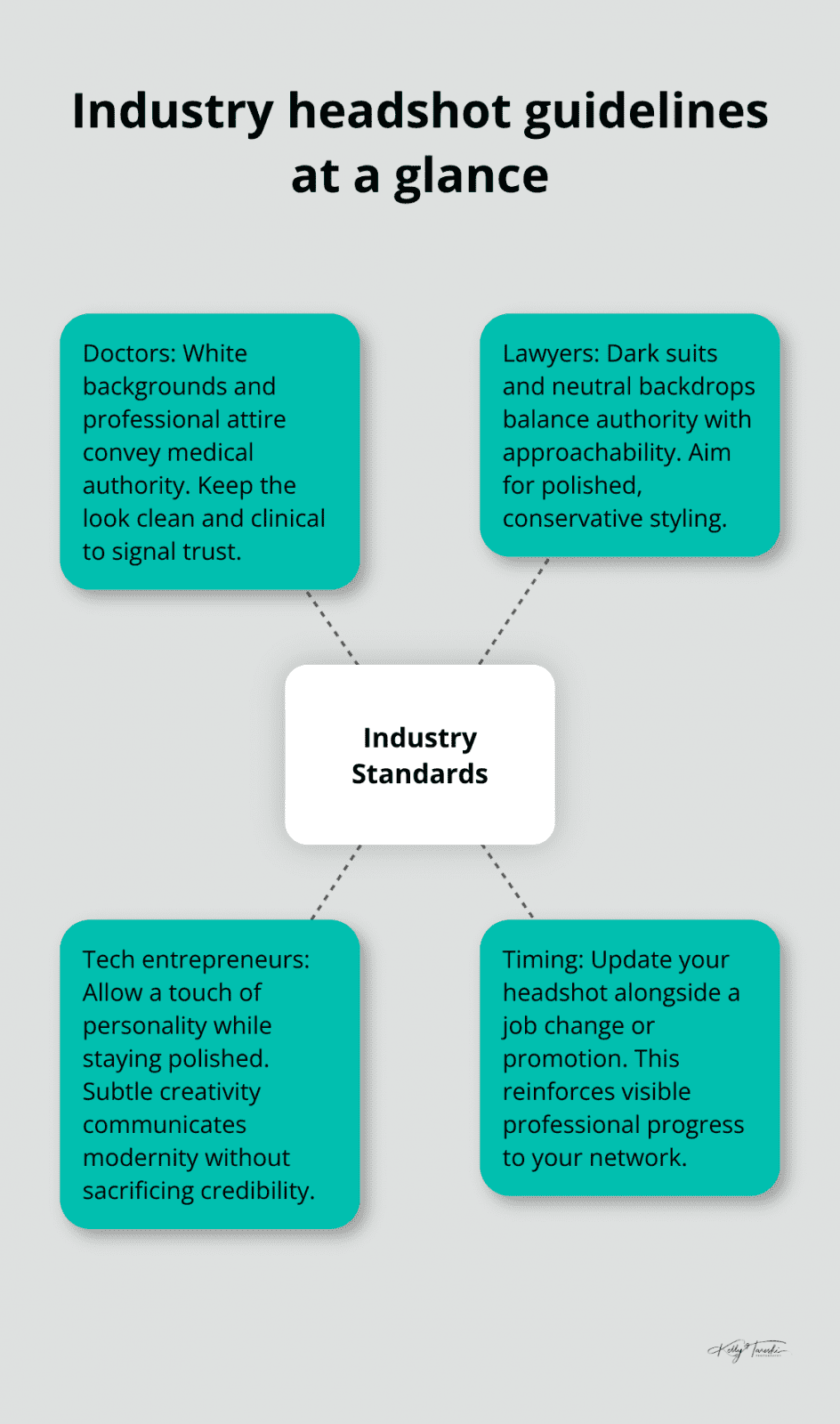
A new image can be useful during a role change, rebrand, website update, speaking engagement, or other transition when your existing photograph no longer fits the materials you need. The next section looks at technical and presentation issues that can make a headshot less useful.
What Can Make a Headshot Less Useful
A professional photo should be current enough that the person is readily recognizable. There is no universal two- or three-year replacement rule, and an older photograph does not prove dishonesty or cause rejection. Update it when your appearance, role, branding, or intended use changes enough that the current image no longer represents you well.
Poor Lighting and Backgrounds Undermine Your Image
Lighting and background should support the face, crop, wardrobe, and intended use. Studio light, window light, environmental light, and outdoor light can all produce professional results when controlled well. Neutral backgrounds are useful for some applications, while workplace or environmental settings can add context. Review the image at the sizes and platforms where it will actually appear.
Coordinate Images When Consistency Helps
Different platforms may need different crops, expressions, backgrounds, or levels of formality. Use the same image or a coordinated set when that makes the professional presentation easier to recognize, but do not assume every variation damages credibility. The important question is whether each image is current, technically suitable, and appropriate for its intended use.
Resolution and Technical Details Matter
The technical side matters significantly: your headshot needs high resolution so it doesn’t pixelate when enlarged, and proper sizing for each platform’s specifications. Many professionals make the mistake of using compressed or low-resolution versions that look blurry on desktop screens. Test your headshot at actual size on your LinkedIn profile, your website, and in email before finalizing.
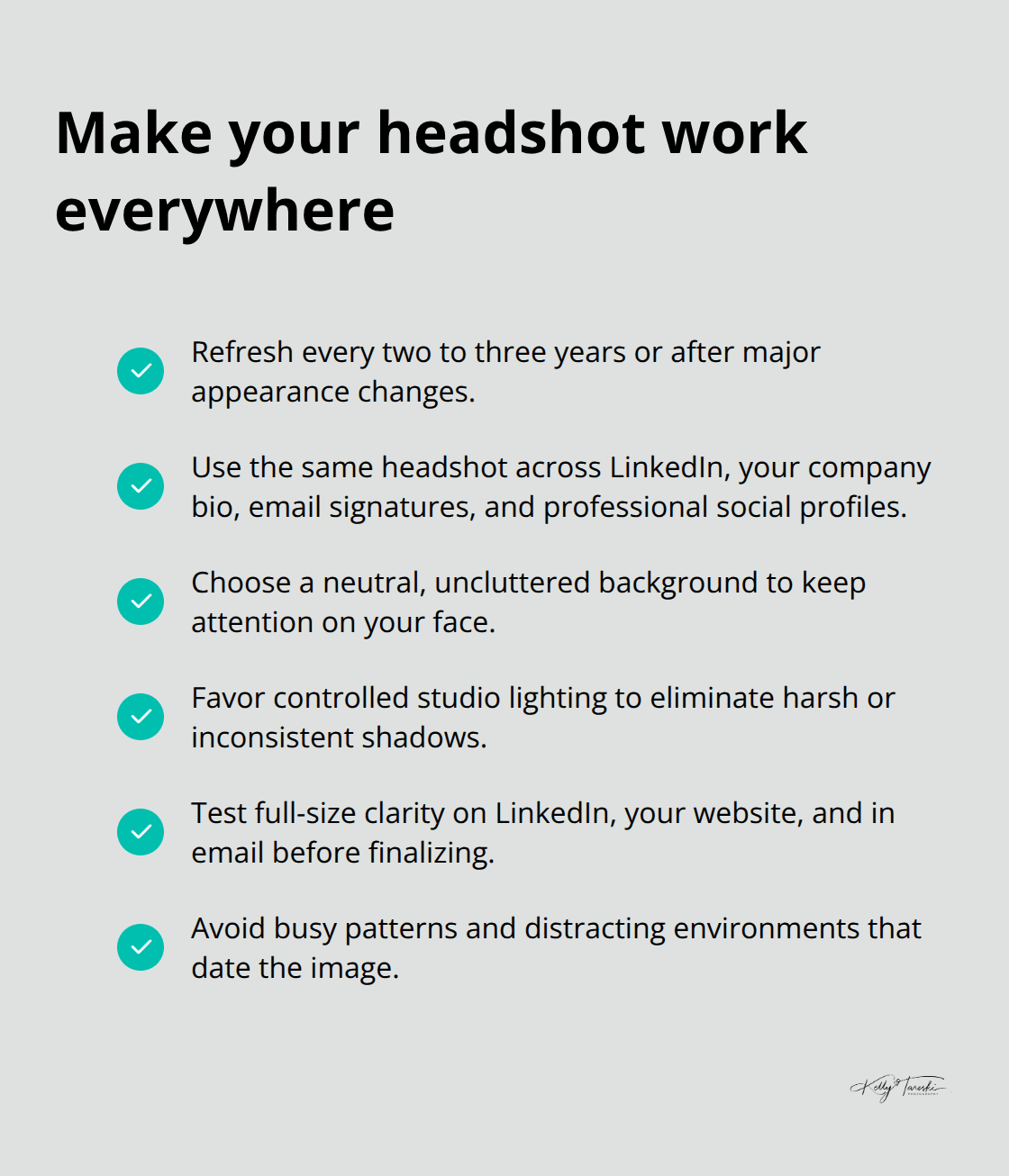
If an image looks unclear or pixelated at the size where it will be displayed, use a larger or less-compressed file when available. Technical image quality affects presentation, but it should not be interpreted as evidence of the person’s work habits or professional competence.
Final Thoughts
A professional headshot can be reused across LinkedIn, websites, email signatures, directories, speaker materials, and other professional platforms. Its practical value comes from providing a current, consistent image in multiple places, not from a guaranteed increase in interviews, recruiter messages, credibility, or career momentum.
A current, technically strong headshot can make your professional materials more consistent and recognizable. It cannot eliminate hiring friction, influence a recruiter in a predictable way, or act as an advocate for your career. Its value is that one well-planned image can be reused across many professional contexts.
At Kelly Tareski Photography, I create headshots around the role, audience, background, wardrobe, expression, crop, and intended use. The goal is a flexible professional image, not a promised career outcome.
Education Most Searched Articles
- Kelly Tareski Photography Homepage
- How to Choose Background Colors to Complement Skin Tones
- Choosing the Best Lens for Stunning Senior Portraits
- 5 Tips Using the Nikon Z7ii Camera for Portrait Photography
- Exploring Spokane Through a Lens: Must-Visit Photo Locations
- How to Choose the Best Lenses for Senior Portraits
- When to Use a Neutral Background in Photography
- Top Posing Ideas for Solo Portraits: Looking Confident and Natural
- The Economy and Photography
- How the Economy Impacts Photography
- How to Weather Economic Slumps as a Photographer
- Finding Creative Ways to Promote Your Photography on a Budget
- Free and Low-Cost Resources for Photographers