
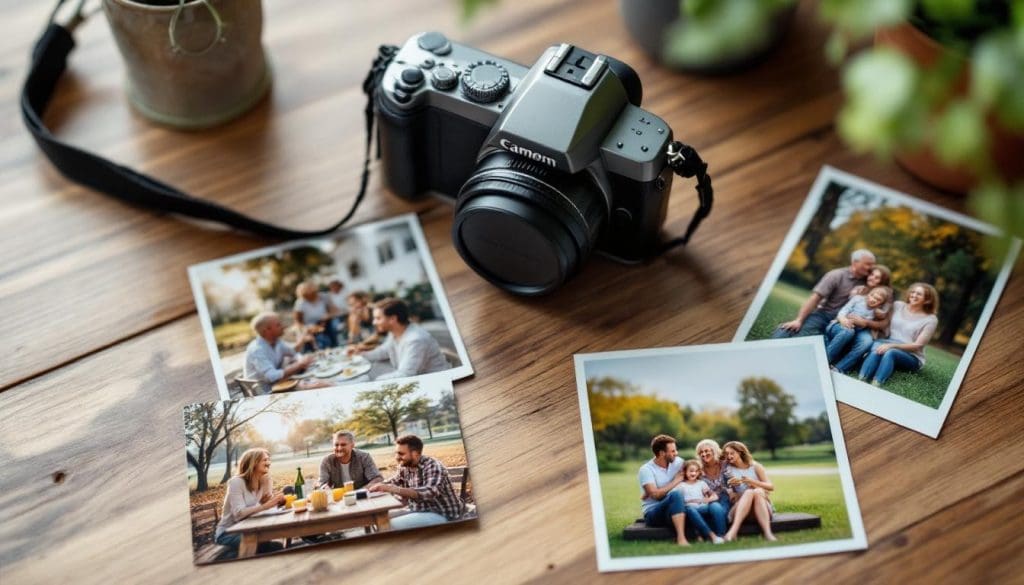
How to Choose Photos for a Balanced Family Album
A balanced family album combines images that do different jobs: an establishing family portrait, smaller relationship groupings, individual expressions, interactions, and meaningful details. Select photographs for the story they tell together rather than filling pages with near-duplicates. There is no required ratio of posed to candid images.
I am Kelly Tareski, a family photographer in Nine Mile Falls near Spokane. When you are deciding how to enjoy your finished portraits, an album gives you space for more than one favorite image. This guide focuses on choosing and sequencing photographs. For the difference between shooting approaches, see candid versus posed family photos.
What story should your family album tell?
Choose a clear starting point: one portrait session, a particular year, a celebration, or a family relationship. That purpose helps you decide which images belong. A session album can stay visually consistent, while a family-year album may intentionally include different locations and everyday snapshots.
Write a short description before selecting photographs. For example: This album remembers our family together while the children were small, including their relationships with their grandparents. It is easier to choose images when you know what the collection is meant to preserve.
Which photographs should you select first?
Begin with the images you would be disappointed to leave out. Then consider whether each important person or relationship is represented. Equal numbers of photographs are not required, but an album should not accidentally omit someone who matters to its story.
- An anchor portrait: An image that introduces the family or central relationship.
- Smaller groupings: Parents with children, siblings together, grandparents, or other meaningful connections.
- Individual character: A recognizable expression or portrait of a family member.
- Interaction: A conversation, shared glance, or moment of movement.
- A detail: An heirloom, familiar gesture, or setting that adds context.
These are possibilities, not a requirement to commission a photograph in every category. Use what the collection genuinely contains.
How do you mix posed and candid images?
Look for variation in expression, distance, and pace. A full-family portrait can establish who is present; a smaller interaction can show how people relate. The images do not need to alternate mechanically between posed and candid.
For example, a spread might pair a guided grandparent-and-child portrait with a quieter moment from the same grouping. Another spread may feature one strong image by itself. Give a photograph space when it deserves attention rather than adding more simply because there is room.
How do you narrow down similar photographs?
Compare near-duplicates together. Ask which expression feels most recognizable, which composition works best for the intended page, and whether a second image adds something genuinely different. Keep two similar photographs when a change in interaction matters; otherwise, choose the one you prefer.
Do not judge every image only by whether everyone faces the camera. A photograph can earn its place through a relationship or detail. The guide to small moments in family photography explains what those quieter images can contribute.
What order makes a family album easy to enjoy?
Try an opening image, a sequence of related moments, and a closing photograph. You can organize by household, relationship, activity, or the flow of the session. Chronological order is useful when time is the story, but it is not the only option.
Review the sequence as a whole. Avoid repeating the same grouping across several pages unless the progression is intentional. A mixture of wider views and closer images can help each section feel distinct without relying on decorative effects.
What should you check before an album is produced?
Confirm the selected product, image count, page or spread terminology, design process, and any proof-approval steps directly. Check names, dates, image order, and important details near page edges or the center fold. Do not assume every digital gallery includes an album or that all photographs will fit the same layout.
An album and a wall portrait can complement each other. Choose a single image for prominent display and let the album hold the fuller story. For smaller arrangements, see arranging family photos on shelves and tables.
Questions about family album selection
How many photographs should be in an album?
The useful number depends on the album format, design, and story. Confirm the available options, then select images that contribute something rather than aiming for the largest possible count.
Can I include phone photographs with professional portraits?
For a personal family-history project, you can consider both. Confirm image quality, permitted use, and the production options before assuming every file will print well or can be included in a studio-designed product.
Do candid images belong in a formal album?
They can. A quiet interaction may sit comfortably beside a polished portrait when both support the same family story. Consistency does not require every image to look alike.
Plan portraits with the finished album in mind
Explore my family portrait sessions near Spokane and current investment information. Contact Kelly Tareski Photography to discuss the people and relationships you want your album to remember.
Education Most Searched Articles
- Kelly Tareski Photography Homepage
- How to Choose Background Colors to Complement Skin Tones
- Choosing the Best Lens for Stunning Senior Portraits
- 5 Tips Using the Nikon Z7ii Camera for Portrait Photography
- Exploring Spokane Through a Lens: Must-Visit Photo Locations
- How to Choose the Best Lenses for Senior Portraits
- When to Use a Neutral Background in Photography
- Top Posing Ideas for Solo Portraits: Looking Confident and Natural
- The Economy and Photography
- How the Economy Impacts Photography
- How to Weather Economic Slumps as a Photographer
- Finding Creative Ways to Promote Your Photography on a Budget
- Free and Low-Cost Resources for Photographers